Category: Uncategorized
Digit 57 Lives!

If you know where this is, then go there and connect to the Digit57 Wifi!
Read this before you “contribute” to an Indiegogo campaign!
Indiegogo is a site that lets you give money to people. It is not a site that lets you buy things from people. There is a big difference.
According to their Terms Of Service….
All Contributions are non-refundable by Indiegogo and are made in your sole discretion and at your sole risk based on your sole determination and evaluation of the Campaign. You are solely responsible for determining the tax deductibility of any Contribution.
[…]
Indiegogo does not represent, warrant or guarantee:
- Perks will be delivered;
- Perks will be satisfactory to you; or
- The use of any Contributions or the outcome of any Campaign. It is up to you, as the Contributor, to ask such questions and undertake such due diligence as you deem necessary before you make a Contribution. Indiegogo may, in its sole discretion and judgment but is under no obligation to, seek the refund of Contributions.
This means that you should not expect to get your money back from IndieGogo if the campaign takes the money and runs. If you don’t get the perk you were promised, it is up to you to try to sue the Campaign Owner.
This is fine if the campaign is to buy a bus ticket for your best friend’s grandma, and the perk is that she will bake you some cookies. This not fine if you think you are buying an $800 high tech product from someone who lives on the other side of the planet.
I am all for Indiegogo’s “let the people decide who to trust, we just facilitate” strategy. They are like the Criagslist to KickStarter’s curated eBay. I love both Craigslist and eBay, and there is a role for both models. Criagslist goes out of its way to make it very clear that they are only an open listing service and that you are dealing with whoever posted the listing, so beware. Indeogogo does not.
The Indiegogo site is filled with the language and iconography of a product sale. The various “perks” are listed as products with prices and estimated delivery dates just like you’d see on Amazon.com or Gap.com. They even show a “2 of 10 left” inventory – implying that 10 of the perk actually ever existed in the first place. When the inventory of a perk is gone, it is labeled with the words “SOLD OUT”. What was sold here?

Come on guys, this is clearly designed to look like you are buying something and not just giving your money to someone. And the users are clearly fooled. Taking a look at the comments, people say stuff like…
- How does one change from a purchase of the $99.00 25 watt system to the $239.00 100 watt system?
- Missed out on the 1kW deal – is there any chance that you will extend it? Would really like to have purchased 4 units.
- I seperately ordered 2 × 500W panels and one 25W panel. I added the 70 USD shipping for the 2 500W panels to the payment of the 25W panel as I forgot before. Hope that’s ok. Looking forward to the product!
- So if I buy one of the 500w, all I have to do is “plug n play”?
The comments speak for themselves – these people believe that they are buying a product, and understandably so.
And while IndieGogo does talk about the democratic nature of crowd funding and the need for you to ask questions and make your own decisions, you are not allowed to post a question until after you’ve committed to give your money. That would be ok, except for the fact that once you have committed your money so you can publicly ask your question, there is no way to then cancel your commitment if you don’t like the answer you get! Kafka! This is not compatible with helping the crowd generate and share information so people make informed decisions, and I can not think of any good business or strategic or legal reason why you would stop people from canceling a contribution any time while the campaign is still running. Can you?
Indiegogo needs to get their act together. At very least make it so people can ask public questions before committing money. And then make it so people can cancel a contribution when they find out something that sours them on it. Then change the user interface so it is clear that you are giving money and not buying something. The only action button on a campaign page should be “I want to give money to this campaign!” rather than a product selection rubric. The next page can show the “perks”, but with plenty of disclaimer language like “These are some things the campaign may be able to send you as a thank you for your contribution, but IndieGogo makes no representations as to the campaign’s ability to actually deliver these goods, and your only recourse if you are unhappy to try to sue [insert campaign lister’s name here] directly.”
Not sexy, but at least honest.
UPDATE 11/29/2018
Indegogo announced a “guaranteed ship” program that sellers can opt into..
…but note that it is only for “marketplace” orders and not for crowdfunding campaigns. Marketplace is basically a marketing and shopping cart service for existing products.
Source code for CSCANPST tool now available!
CSCANPST is now officially open source. You can read about it here…
…or just grab the bits here…
https://github.com/bigjosh/CSCANPST
This should make it much easier for others to do translations to other languages and add support for future Outlook versions.

Elevator power usage – should I take the stairs?
I’ve always wondered how much power elevators use and how efficient they are. This seemed like a perfect job for the new TED Pro 3-phase power monitor.
I hooked up the monitor and then sent the elevator up and down a couple of times empty and with two different weight loads…
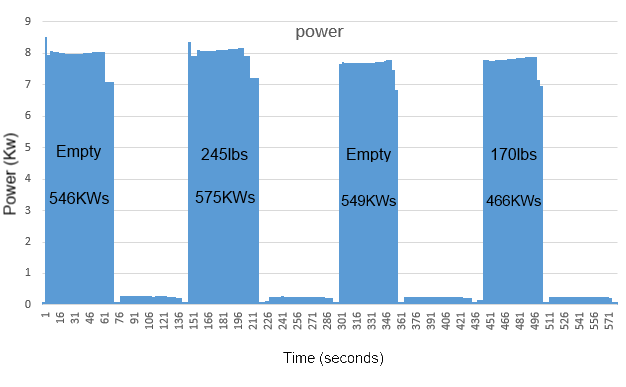
Big bars are the elevator going up, short ones are the elevator going back down.
Interesting observations:
- The elevator controller uses about 83 watts all the time, even when the elevator is idle. That’s about $130 per year without even moving!
- Going up uses almost 40 times as much power as going down.
- Going up 5 floors uses about 500 kilowatt seconds and costs about $0.03.
- It does not seem to consistently take more power to lift a full elevator than an empty one.
- It takes more power to lift an elevator that has been sitting idle for a while than one that is “warm”.
- My guess is that there is more friction on a “cold” elevator because each use lubricates the piston. This would also explain the energy spike at the very beginning of the first two lifts as the the elevator breaks the initial static holding friction.
- Going up with a load takes a few seconds longer than going up empty.
Notes:
- This is a hydraulic lift elevator. The total travel is 5 floors/55 feet. I weigh about 170lbs.
- I used my local ConEd electric rates of $0.18/KWh ($0.10/KWh for power, $0.08/KWh for delivery).
- The elevator slows down as it gets close to the target landing so that it doesn’t overshoot. This is the reason for the “shelf” at the end of each lift bar.
- To go up, you pump high pressure hydraulic fluid into the piston. To go down, you open a valve and let the pressure out.
So, should you take the stairs?
Elevator: ~550KWs
Stairs: 92KWs / (22 calories)
Magic: 12KWs (the theoretical minimum possible)
If the elevator is going up anyway, then you should hop on since your additional weight has almost no effect on the total power used.
If you are considering taking the elevator alone, you should take the stairs.
-josh
New Year, New Website
Since 1996, I’ve been happily building the josh.com website the hard way using HTML and hosting it the hard way on big j isp‘s servers, and it shows.
Fist Hurricane Sandy simultaneously took out all my servers in both NYC and South NJ. Then Microsoft announced that is was canceling their Expression Web HTML editor.
I can take a hint. Today I am finally moving to WordPress.com. Everything is now fancy.
You can still find the complete old website as of 12/31/2012 here…

…and all links into the old site should still work.
There is an even older website circa 1999 here…

…which features Pete’s avant-garde Java game ad that amazingly still works, but is too fast now to play.
Hopefully this solution will last me another 15 years, or until I lose josh.com !
Some Art
big
-big dome

https://dusk.space/statement.html
https://www.instagram.com/explore/tags/duskspace/
-big clock

https://github.com/bigjosh/De-Harak-Clock-Controller/blob/master/README.md
performative
-made you mine
-made you ride

-made you ico

-made you trump

https://wp.josh.com/2016/07/04/trumpwap-make-the-web-great-again/
-made you the condemned

https://photos.app.goo.gl/AWbeFwZGGyuLV2J27
-made a flame

(that’s all for now)