


I’ve always wondered how much power elevators use and how efficient they are. This seemed like a perfect job for the new TED Pro 3-phase power monitor.
I hooked up the monitor and then sent the elevator up and down a couple of times empty and with two different weight loads…
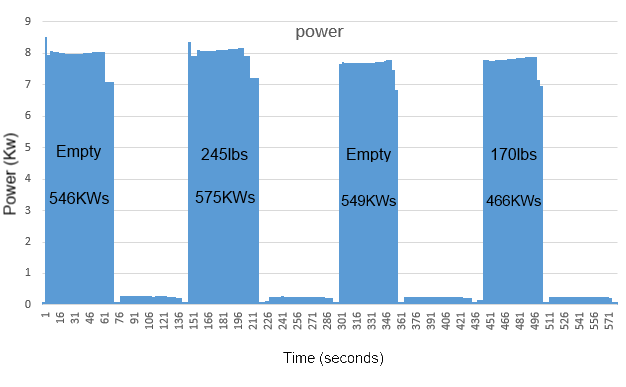
Big bars are the elevator going up, short ones are the elevator going back down.
Interesting observations:
- The elevator controller uses about 83 watts all the time, even when the elevator is idle. That’s about $130 per year without even moving!
- Going up uses almost 40 times as much power as going down.
- Going up 5 floors uses about 500 kilowatt seconds and costs about $0.03.
- It does not seem to consistently take more power to lift a full elevator than an empty one.
- It takes more power to lift an elevator that has been sitting idle for a while than one that is “warm”.
- My guess is that there is more friction on a “cold” elevator because each use lubricates the piston. This would also explain the energy spike at the very beginning of the first two lifts as the the elevator breaks the initial static holding friction.
- Going up with a load takes a few seconds longer than going up empty.
Notes:
- This is a hydraulic lift elevator. The total travel is 5 floors/55 feet. I weigh about 170lbs.
- I used my local ConEd electric rates of $0.18/KWh ($0.10/KWh for power, $0.08/KWh for delivery).
- The elevator slows down as it gets close to the target landing so that it doesn’t overshoot. This is the reason for the “shelf” at the end of each lift bar.
- To go up, you pump high pressure hydraulic fluid into the piston. To go down, you open a valve and let the pressure out.
So, should you take the stairs?
Elevator: ~550KWs
Stairs: 92KWs / (22 calories)
Magic: 12KWs (the theoretical minimum possible)
If the elevator is going up anyway, then you should hop on since your additional weight has almost no effect on the total power used.
If you are considering taking the elevator alone, you should take the stairs.
-josh